$130/mo HVAC Installation Financing - Get a Free Estimate

HVAC stands for heating, ventilation, and air conditioning. It is the system that warms your home in winter, cools it in summer, and keeps clean, filtered air moving through every room. In the Coachella Valley, where July highs average around 107°F, it is also the hardest-working piece of equipment in your house. This guide explains what HVAC means, the parts that make up a system, how those parts work together, and which type of system fits a desert home.
HVAC is an acronym for the three jobs your system does every day. Each letter covers a different part of your home's comfort:
Heating warms your home when temperatures drop, using a furnace, a heat pump, or electric heat strips. In the valley, heating season is short, but cold desert nights still call for a system that responds quickly.
Ventilation moves air through your home. It circulates conditioned air to each room, pulls stale air back to the system, and runs it through a filter so dust, pollen, and pet dander are trapped instead of breathed in.
Air conditioning cools your home by removing heat and humidity from indoor air and releasing that heat outside. It does not create cold air. It moves heat from where you don't want it to where it doesn't matter.
Not exactly. AC (air conditioning) is one part of an HVAC system. HVAC is the whole package: the heating equipment, the cooling equipment, the fan and ductwork that move air, the thermostat that controls it all, and the filters that clean the air. When someone says "my HVAC is out," they could mean any one of those parts.
An HVAC system is not a single machine. It is a team of components inside and outside your home, and each one has to do its job for the whole system to keep you comfortable. Here are the parts you will find in most Coachella Valley homes.
"A system is only as strong as its weakest part. When one component struggles, comfort, efficiency, and your utility bill all feel it."
Proformance Service Team
A central air conditioner has two halves. The condenser sits outside and holds the compressor and a large fan. The evaporator coil sits inside, on top of your furnace or air handler. Refrigerant travels between the two through copper lines, absorbing heat indoors and releasing it outdoors. Learn more about AC installation and what to expect from a new system.
A heat pump looks like an air conditioner and cools the same way, but it can also run in reverse. In winter it pulls heat from the outdoor air and moves it inside, which makes it an efficient all-electric option for both heating and cooling. Because valley winters are mild, heat pumps are one of the most popular upgrades we install.
A furnace heats air by burning natural gas or propane, or by running electric heating elements. A blower then pushes that warm air through your ducts. Many valley homes pair a gas furnace with a central AC. See our heating installation options for furnaces and heat pumps.
The air handler is the indoor unit that houses the blower fan, the evaporator coil, and often backup electric heat strips. It is usually paired with a heat pump in homes without a furnace. Think of it as the engine that moves air through your home.
A mini-split connects an outdoor unit to one or more wall-mounted indoor units, with no ductwork required. Each indoor unit heats and cools its own zone. Mini-splits are a great fit for casitas, garage conversions, sunrooms, additions, and older homes without ducts.
Ducts are the highways for your home's air. Supply ducts deliver heated or cooled air to each room, and return ducts pull air back to the system to be filtered and conditioned again. Leaky, crushed, or undersized ducts can make even brand-new equipment underperform.
The thermostat is the command center. It reads the temperature in your home and tells the system when to turn on, when to shut off, and whether to heat or cool. Smart thermostats add scheduling, remote control from your phone, and maintenance alerts.
Every system has an air filter that catches dust and debris before it reaches the equipment or your lungs. Add-ons like UV lights, air scrubbers, electronic filtration, and whole-home humidifiers take indoor air quality further, which helps households with allergies, asthma, or sensitivity to dry desert air.
At its core, an HVAC system does two things: it changes the temperature of your air, and it moves that air through your home. Here is what happens during a typical cooling cycle, from the moment your thermostat calls for cool air:
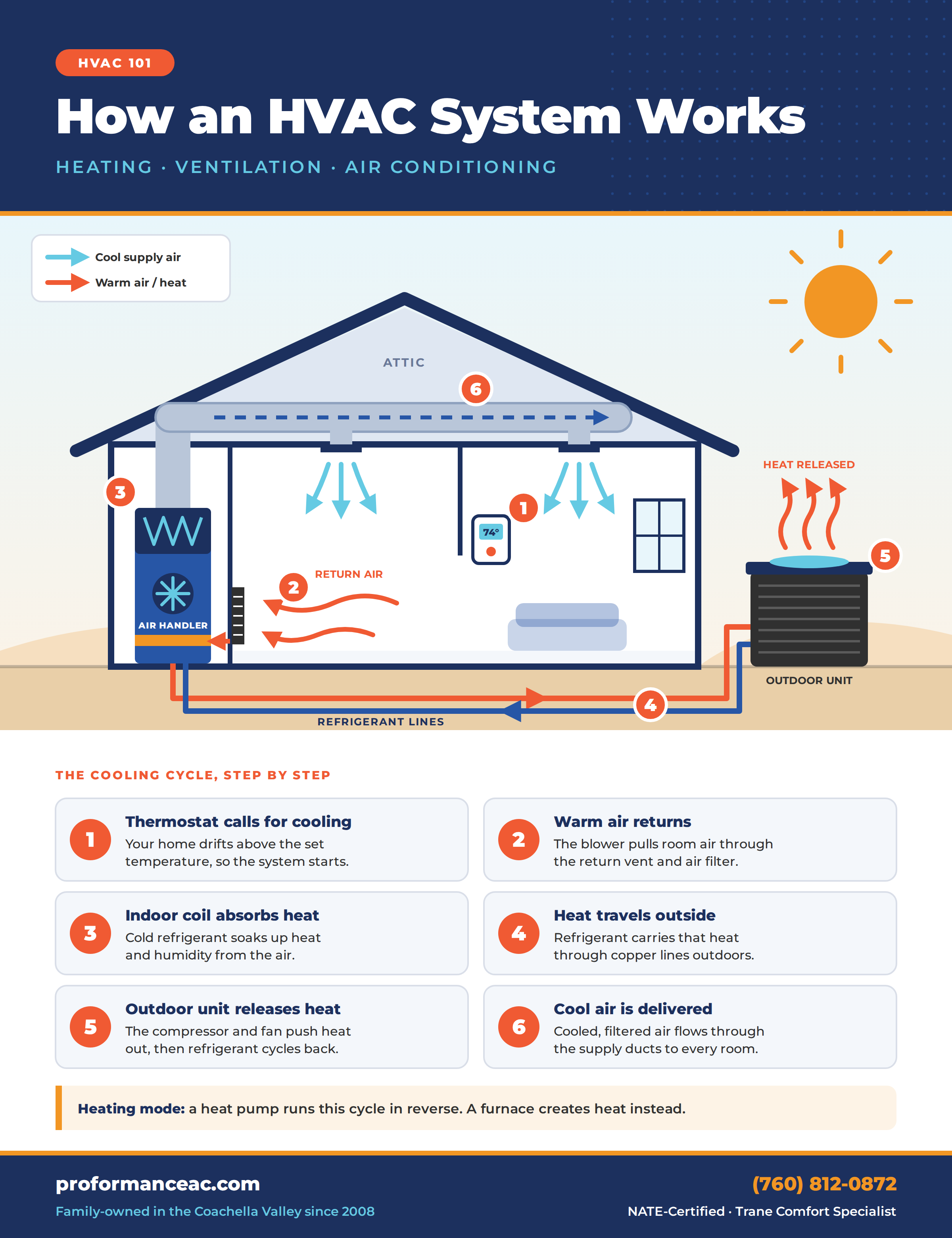
[INFOGRAPHIC PLACEHOLDER: replace this line with how-an-hvac-system-works-infographic-proformance.webp. Alt text: Infographic showing how an HVAC system works in six steps: the thermostat calls for cooling, warm air returns through the filter, the indoor coil absorbs heat, refrigerant carries the heat outside, the outdoor unit releases it, and cool air flows through supply ducts to every room. Caption: How an HVAC system moves heat out of your home during the cooling cycle.]
Heating follows the same path through your ducts, with a different heat source. A heat pump runs its refrigerant cycle in reverse, pulling heat from the outdoor air (yes, even on a 40°F night) and releasing it indoors. A furnace creates heat by burning gas or running electric elements, then the blower sends that warm air through the supply ducts. Either way, the thermostat controls the cycle and the ducts deliver the result.
Conditioning the air is only half the job. Your system also has to move it, evenly, to every room. Airflow is what keeps comfort consistent from the living room to the back bedroom.
The blower lives inside your furnace or air handler. When the system turns on, it pushes air across the heating or cooling coil and into the ducts. A weak or failing blower means less air at your vents, even if the rest of the system is working perfectly.
In many valley homes, the ducts run through the attic, where summer temperatures can climb past 140°F. Every leak or gap in that ductwork lets cooled air escape into the hottest part of the house and pulls hot, dusty attic air into your system. According to ENERGY STAR, sealing and insulating ducts can improve heating and cooling efficiency by as much as 20 percent.
"If the equipment is the heart of your home's comfort, the ducts are the arteries. Your airflow is only as good as the path it travels."
Proformance Service Team
Most homeowners think of the thermostat as a temperature dial. In reality, it is the brain of the entire HVAC system.
The thermostat constantly measures your indoor temperature. When it drifts away from your set point, the thermostat signals the equipment to start heating or cooling, and it shuts the system off once your home is back on target.
Modern smart thermostats, including the connected controls available with Trane and Mitsubishi Electric systems, go well beyond a number on a screen:
For seasonal and vacation homeowners, a smart thermostat is especially useful. You can keep the house at a safe temperature while it sits empty all summer, then cool it down before you arrive.
Heating and cooling are only part of the picture. Clean, balanced air is what makes a home feel healthy, and desert living brings its own challenges: blowing dust, pollen, very dry winter air, and the occasional wildfire smoke.
Your filter protects both your lungs and your equipment. In the Coachella Valley, check your filter monthly during the cooling season and replace it every one to three months. Homes with pets, recent construction, or heavy wind exposure may need changes more often. A clogged filter restricts airflow, drives up energy use, and is one of the most common causes of frozen AC coils.
Standard filters don't catch everything. Whole-home air cleaners and electronic filtration capture finer particles, while UV lights and air scrubbers help neutralize bacteria, mold spores, and odors that a filter alone can't trap.
Desert air is dry, and running the heat in winter makes it drier. A whole-home humidifier adds moisture back into the air, which helps with dry skin, irritated sinuses, static shocks, and cracking wood floors and furniture.
"Air quality is the comfort you can't see, but you can feel it every time you take a breath."
Proformance Service Team
Not every home uses the same setup. The right system depends on your home's layout, whether you have ductwork, your energy preferences, and your budget. Here is a quick comparison of the most common options:
You may also see evaporative (swamp) coolers on older desert homes. They cool by evaporating water and work best in very dry air, but they lose effectiveness during humid monsoon stretches and don't provide heating or filtration the way a full HVAC system does.
A system in Indio, Palm Desert, or La Quinta lives a very different life than one in a mild coastal city. Here is what makes desert HVAC unique:
The right system isn't about picking the biggest unit or the most popular brand. It is about matching the equipment to your home and how you live in it. Here is what we look at:
A proper load calculation looks at square footage, ceiling height, room layout, and number of stories. An oversized system turns on and off too often and struggles to control humidity. An undersized one runs nonstop and still can't keep up on a 110°F afternoon.
West-facing windows, older single-pane glass, and thin attic insulation all add heat load. Two homes with the same square footage can need very different systems.
Higher-efficiency systems cost more up front and save more every month, and in a climate with this much cooling demand, the savings add up quickly. The federal 25C energy efficiency tax credit ended on December 31, 2025, but local utility rebates, such as those offered by IID, may still apply to qualifying systems. Proformance also offers 0% financing on select HVAC packages, with new systems starting at about $130 a month.
Sometimes new equipment can connect to your existing ducts. Other times, the ducts need to be repaired, resized, or replaced for the new system to perform the way it should. If your home has no ducts at all, a ductless mini-split may be the better path.
The best way to avoid a breakdown in the middle of July is regular care. A few simple habits go a long way:
Our Pro Care Club makes this easy. For $170 a year per system, you get two maintenance visits, 15% off repairs, priority service, and no after-hours fees. Learn more about AC maintenance and heating maintenance, or see full pricing.
HVAC stands for heating, ventilation, and air conditioning. It refers to the complete system that heats, cools, filters, and circulates air in your home, including the outdoor unit, indoor unit, ductwork, thermostat, and air filters.
No. Air conditioning is one part of an HVAC system. HVAC also includes the heating equipment, the ventilation and ductwork that move air, and the controls and filters that keep the whole system running.
Most air conditioners and heat pumps last around 10 to 15 years, and furnaces often last longer. In the Coachella Valley, long cooling seasons and dust exposure can shorten that range, which is why regular maintenance matters so much here.
Twice a year is the standard for desert homes: once in spring before cooling season and once in fall before heating season. Seasonal and vacation homes also benefit from a startup check before the owners return.
Both cool your home the same way. The difference is that a heat pump can reverse its cycle to heat your home in winter, while an air conditioner only cools and is usually paired with a furnace for heating.
SEER2 is the current efficiency rating for air conditioners and heat pumps. The higher the SEER2 number, the less electricity the system uses to deliver the same cooling over a season. In hot climates, it is also worth comparing EER2, which measures efficiency at peak heat.
An HVAC technician installs, maintains, diagnoses, and repairs heating, cooling, and air quality equipment. Look for NATE-certified technicians, which means they have passed industry-recognized testing on HVAC knowledge and skills.
The cost depends on your home's size, the type of system, efficiency level, and whether ductwork needs work. Proformance provides a written quote after an in-home evaluation, and financing is available with new systems starting at about $130 a month.
Now that you know how HVAC works, you're better equipped to spot problems early and make a confident decision when it's time to repair or replace. If your system isn't keeping up, or you want a second opinion on what your home needs, Proformance Heating & Air is here to help. Family-owned since 2008 and led by NATE-certified technicians, we serve homeowners across the Coachella Valley. Schedule online or call (760) 812-0872.